Categories
Planning & Policy

Defining and Structuring IT and Cybersecurity Roles for Local Governments

As local governments modernize their operations and expand digital services, the need for clear, well-structured roles in IT and cybersecurity has never been more urgent. From online permitting platforms to cloud-based data systems, municipalities are increasingly reliant on technology to deliver public services. But with this reliance comes risk—and the responsibility to manage it effectively.

One of the most important steps in building cyber resilience is clarifying the distinction between IT and cybersecurity functions. While these domains are closely related, they serve fundamentally different purposes and must be structured accordingly.

Why Role Clarity Matters

Strong governance depends on clear role definitions. When IT and cybersecurity responsibilities are blurred, security can be compromised by operational urgency or budget constraints. For example, if a city launches a new online permitting system, the IT team may focus on uptime and user experience, while cybersecurity professionals ensure that sensitive resident data is encrypted, access is controlled, and third-party risks are assessed.

This separation allows cybersecurity teams to assess risk independently and advocate for protections that may not align with short-term operational goals—but are essential for long-term resilience.

Structuring Roles: A Governance-Aligned Approach

The Enterprise Governance of Information and Technology (EGIT) framework provides a model for structuring IT and cybersecurity roles in a way that supports strategic alignment and risk-informed decision-making.

1. Functional Separation

  • IT Departments: Focus on deploying and maintaining technology systems that support operations.
  • Cybersecurity Teams: Focus on protecting data, systems, and infrastructure from threats.

This separation ensures that cybersecurity professionals can operate without being subordinated to project timelines or budget pressures.

2. Leadership Accountability

Cybersecurity is not just a technical issue—it’s a leadership responsibility. Elected officials, department heads, and senior executives must recognize that cyber risk affects their ability to deliver services and maintain public trust.

3. Defined Responsibilities Across Roles

Every employee in local government has a role in cybersecurity—from locking devices and reporting suspicious activity to completing training and following data protection protocols.


Examples of Role Definitions

RolePrimary FocusKey Responsibilities
IT DirectorOperational technologySystem uptime, software deployment, vendor management
Cybersecurity OfficerRisk managementThreat detection, incident response, policy enforcement
Department HeadsStrategic oversightAligning tech use with service goals, ensuring compliance
Frontline StaffDaily operationsFollowing security protocols, reporting incidents

Local governments must build governance structures that support both innovation and protection. By clearly defining and separating IT and cybersecurity roles, municipalities can:

  • Make unbiased, risk-informed decisions.
  • Respond more effectively to threats.
  • Build a culture of cybersecurity across all departments.

Categories
Leadership & Governance Tools & Guidance

A Cybersecurity Governance Checklist for Public Leaders

In today’s digital-first environment, local government leaders face complex decisions that impact everything from emergency service delivery to the sanctity of public trust. Whether you are evaluating a smart-city initiative, managing vendor ecosystems, or passing a budget, cybersecurity is the foundation of your legacy. It cannot be a technical afterthought; it must be a governance cornerstone.

By leveraging the Enterprise Governance of Information and Technology (EGIT) framework, officials can move away from “hoping for the best” and toward a structured, risk-aware culture. This checklist is designed to empower non-technical decision-makers to ask the “hard questions” that balance progress with protection.


The Strategic Cybersecurity Checklist for Decision-Makers

Use this checklist to guide discussions and ensure cybersecurity is considered at every stage of planning and implementation:

1. Strategic Alignment

  • Mission Criticality: Does this technology directly improve a core public service, or does it add unnecessary complexity to our digital footprint?
  • Trust Continuity: If this system fails for 48 hours, what is the specific impact on citizen trust and public safety?
  • Resilience Planning: How does this investment help us maintain operations during a natural disaster or digital outage?

2. Risk Oversight

  • The “Shadow” Risk: Beyond the software itself, what access does the vendor have to our broader network?
  • Expert Consultation: Have we received a formal risk assessment from our CISO or an independent third party before signing the contract?
  • Internal vs. External: Are we prepared for internal human error (training gaps) as much as external hacker threats?

3. Compliance and Legal Obligations

  • Mandate Mapping: Does this solution strictly adhere to CJIS (Criminal Justice), HIPAA (Health), or PCI-DSS (Financial) standards?
  • Liability: Who is contractually liable for data notification costs in the event of a breach—the municipality or the vendor?
  • Regulatory Evolution: How will we audit this system next year to ensure it stays compliant with changing state and federal laws?

4. Data Protection and Privacy

  • Data Minimization: Are we collecting more data than is strictly necessary? (Remember: Data you don’t have can’t be stolen).
  • Encryption Standards: Is data encrypted both “at rest” (on the server) and “in transit” (moving between users)?
  • Access Control: Do we follow the “Principle of Least Privilege,” ensuring that staff see only the data they need for their specific job?

5. Roles and Responsibilities

  • The “Buck Stops Here”: Which specific executive (not just the IT manager) owns the ultimate risk of this project?
  • Vendor Accountability: Are security expectations explicitly written into the Service Level Agreement (SLA)?
  • Cross-Departmental Synergy: Do the Legal and HR department know their role in this digital initiative?

6. Incident Preparedness

  • The “Blast Radius”: If this system is compromised, is it isolated (segmented) so it won’t take down our entire government infrastructure?
  • Detection Speed: How long would it take us to realize a breach has occurred—minutes, or months?
  • Recovery Roadmap: Do we have off-site, immutable backups to restore services without paying a ransom?

7. Budget and Resources

  • Total Cost of Ownership (TCO): Does the budget include “Life-Cycle Security”—including future patching, auditing, and eventual decommissioning?
  • The Security Tax: Is at least 10-15% of this project’s budget dedicated specifically to security and oversight?

8. Performance and Monitoring

  • Success Metrics: Do we have “Key Risk Indicators” (KRIs) that tell us if the security health of this project is declining?
  • Audit Cadence: How often will we perform a “vulnerability scan” on this new technology?

9. Public Communication

  • Transparency Strategy: How will we proactively explain our security measures to constituents to build confidence?
  • Crisis Messaging: Do we have a pre-drafted communication plan to inform the public if their data is compromised, ensuring we maintain transparency while managing the crisis?

Cybersecurity is no longer a sub-bullet of the IT budget; it is the “guardrail” that allows local government to move fast without falling off the cliff. By utilizing this checklist, decision-makers shift the culture from reactive crisis management to proactive resilience.

The goal isn’t just to be “secure”—it’s to be “governed.”

Categories
Leadership & Governance

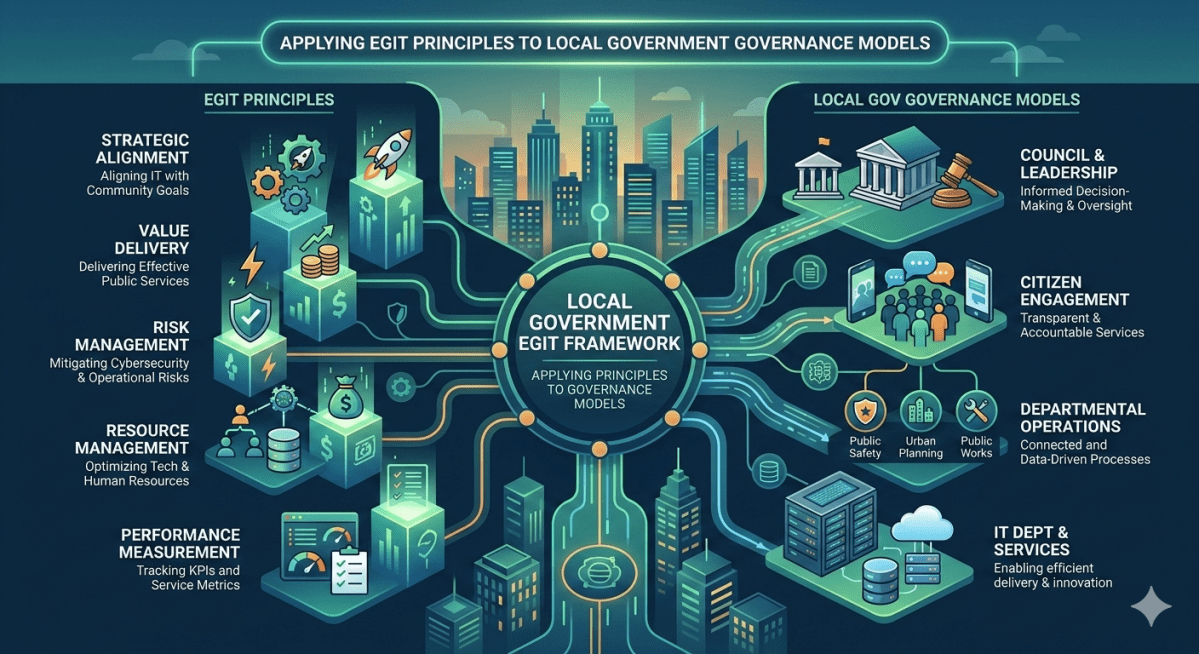
Applying EGIT Principles to Local Government Governance Models

As local governments embrace digital transformation, they face a dual challenge: delivering efficient, citizen-centered services while managing the growing risks of operating in a digital-first environment. One essential model for supporting this shift is the Enterprise Governance of Information and Technology (EGIT) framework. EGIT enables municipalities to align technology investments and digital service delivery with broader goals such as resilience, transparency, and public trust 

At its core, EGIT emphasizes two interdependent responsibilities:

  • Delivering value to the public through the effective use of data and digital tools.
  • Managing risk, including cybersecurity, as an integral part of governance.

To operationalize these principles, local governments can explore example governance models that support strategic alignment across departments.


Model 1: Risk-Informed Leadership Structure

This model integrates EGIT by embedding cybersecurity and digital risk into executive decision-making. Department heads and elected officials receive regular briefings on technology risks, and cybersecurity leaders participate in strategic planning sessions.

EGIT Application:

  • Risk is treated as a governance issue, not just a technical one.
  • Technology decisions are evaluated for both service impact and risk exposure.
  • Cybersecurity leaders have a seat at the table, ensuring independent risk assessments.

Model 2: Functional Separation of IT and Cybersecurity

EGIT calls for a clear distinction between IT operations and cybersecurity oversight. In this model, IT teams focus on service delivery and infrastructure, while cybersecurity teams independently assess threats, monitor compliance, and guide risk mitigation.

EGIT Application:

  • Prevents operational demands from compromising security.
  • Enables unbiased risk reporting and prioritization.
  • Supports resilience by ensuring that security is not subordinated to convenience or cost.

Model 3: Departmental Alignment Through Governance Councils

This model establishes a cross-functional governance council that includes representatives from IT, cybersecurity, finance, legal, and public services. The council reviews technology initiatives, evaluates risk, and ensures alignment with strategic goals.

EGIT Application:

  • Promotes transparency and shared accountability.
  • Aligns digital investments with community priorities.
  • Facilitates coordinated responses to emerging threats.

Model 4: Citizen-Centric Digital Service Oversight

EGIT emphasizes delivering public value. This model focuses on measuring the impact of digital services—such as online permitting, emergency alerts, and citizen portals—against metrics like accessibility, equity, and trust.

EGIT Application:

  • Uses data to evaluate service performance and user satisfaction.
  • Ensures that digital tools enhance—not hinder—public engagement.
  • Balances innovation with privacy and security protections.

EGIT is more than a framework—it’s a mindset. By applying EGIT principles to governance models, local governments can build structures that support innovation while safeguarding public assets. Whether through leadership integration, functional separation, or cross-departmental alignment, EGIT helps municipalities navigate the complexities of digital transformation with confidence and clarity.

Categories
Cybersecurity Basics

Why Hackers Hack: Understanding Cyber Threat Motivations

Cyberattacks are not random acts of digital vandalism—they are calculated, purposeful, and often deeply strategic. To effectively defend against these threats, local governments must understand not just how hackers operate, but why they do it. The motivations behind cyberattacks are as diverse as the actors themselves, ranging from financial greed to ideological warfare.

Why Motivation Matters

To build stronger defenses, local government leaders must not only know who is behind cyber incidents, but also why they occur:

  • Prioritize defenses based on threat likelihood.
  • Identify high-risk assets and systems.
  • Tailor incident response plans to attacker profiles.
  • Improve staff awareness and training.

Motivations Behind Cyber Threats

MotivationActorsWhat They DoExamples
Financial GainOrganized Crime, Cybercriminals, InsidersExtort money, steal data for resale, manipulate systems for profitRansomware (REvil, Conti), BEC scams, data breaches, cryptojacking
Political ActivismHacktivists, Nation-StatesTarget governments or corporations to advance political agendasWebsite defacement, leaks tied to causes (e.g., Flint water crisis, Ukraine conflict)
EspionageNation-States, Insiders, Foreign Intelligence ServicesSteal sensitive data or intellectual property for strategic advantageAPT10 targeting defense contractors, research theft
Terrorism & DisruptionCyber Terrorists, Nation-StatesAttack infrastructure to cause fear or instabilityPower grid sabotage, water system disruption
Ideological MotiveHacktivists, InsidersAttack perceived enemies of their beliefsData leaks targeting anti-abortion groups or political dissenters
Mischief & Thrill-SeekingScript KiddiesLaunch attacks for fun, curiosity, or recognitionDDoS attacks, website defacement, bragging rights
Retaliation & GrudgeInsiders, HacktivistsSeek revenge against organizations or individualsDisgruntled employees leaking data or sabotaging systems
Social ChangeHacktivistsPromote civil disobedience or social justiceAttacks tied to BLM, environmental protests, anti-censorship

Implications for Local Governments

Understanding the motivations behind cyberattacks is not just an academic exercise—it’s a practical necessity for local government leaders. Each motivation corresponds to different tactics, targets, and levels of sophistication. For example:

  • Financially motivated attackers may exploit vulnerabilities in payment systems, tax databases, or procurement platforms.
  • Politically motivated actors might target law enforcement, election systems, or public health departments to make a statement or disrupt operations.
  • Insiders with grievances could misuse access to leak sensitive data or sabotage systems from within.

This diversity in threat profiles means that a one-size-fits-all approach to cybersecurity is insufficient. Local governments must tailor their defenses to the specific risks they face, based on the motivations most likely to target their operations.

Turning Insight into Action

To effectively counter these threats, municipalities should adopt a motivation-aware cybersecurity strategy. Here are key steps to consider:

1. Threat Modeling Based on Motivation

Map out which motivations are most relevant to your organization. For example, if your agency handles sensitive personal data, financial gain and espionage may be top concerns. If your work intersects with controversial public policies, ideological motives and hacktivism may be more likely.

2. Layered Defense Architecture

Implement multiple layers of security controls—technical, administrative, and physical—to protect against both external and internal threats. This includes firewalls, endpoint protection, access controls, and data encryption.

3. Insider Risk Management

Develop policies and monitoring systems to detect and prevent insider threats. This includes background checks, access reviews, and behavioral analytics to identify anomalies.

4. Staff Training and Awareness

Educate employees on the tactics used by different threat actors. Tailored training can help staff recognize phishing attempts, social engineering, and suspicious behavior.

5. Incident Response Planning

Prepare for different types of attacks by creating scenario-based response plans. A ransomware attack requires a different response than a politically motivated data leak or a DDoS attack launched for mischief.

Cybersecurity is not just about technology—it’s about understanding human intent. By recognizing the motivations behind cyberattacks, local governments can build smarter, more resilient defenses that protect public trust and ensure continuity of services.

Categories
Cybersecurity Basics

Know Your Enemy: The 8 Types of Cyber Threat Actors

Cybersecurity is no longer a niche concern—it’s a frontline issue for local governments. From ransomware attacks that paralyze public services to data breaches that expose sensitive resident information, the threat landscape is growing more complex and dangerous. At the heart of this digital battleground are the cyber threat actors, often referred to as “bad actors.” These individuals or groups exploit technology to conduct malicious activities such as hacking, phishing, and malware deployment.

Bad Actors vs. Defenders: The Asymmetry of Cyber Conflict

The economic dynamics of cybersecurity are starkly imbalanced. Attackers only need to succeed once, while defenders must be flawless every time. This asymmetry creates a daunting challenge for local government cybersecurity teams.

  • Low Cost of Entry for Attackers: The barrier to entry for launching cyberattacks has never been lower. On the dark web, malicious tools and services are readily available for purchase or rent. For example:
    • Ransomware-as-a-Service (RaaS) platforms allow even non-technical criminals to deploy sophisticated attacks.
    • Phishing kits with pre-built templates and spoofing tools can be bought for under $50.
    • DDoS-for-hire services can be used to overwhelm public websites or internal systems for as little as $200.
  • High Cost for Defenders: In contrast, defenders must secure every endpoint, every user, and every system—24/7. Even a single overlooked vulnerability can lead to catastrophic consequences. For local governments, this means:
    • Maintaining up-to-date patches across legacy systems that may not be easily upgradeable.
    • Training staff to recognize and report phishing attempts, despite high turnover or limited cybersecurity awareness.
    • Monitoring networks for anomalies, often without a dedicated security operations center (SOC).
    • Complying with regulations and reporting requirements, which add administrative overhead.

This uneven playing field means attackers can afford to be opportunistic, while defenders must maintain constant vigilance.

The Imbalance in Risk and Reward

This asymmetry creates a risk-reward imbalance:

AspectAttackersDefenders
CostLow (tools are cheap or free)High (tools, staff, training, compliance)
EffortOne successful exploit is enoughMust defend all vectors, all the time
RiskOften anonymous, low legal riskHigh accountability, legal and reputational consequences
ScaleCan automate and replicate attacksMust tailor defenses to each system and user

For defenders, the cost of failure is steep:

  • Financial Losses: Ransom payments, recovery costs, and lost revenue.
  • Reputational Damage: Loss of public trust, especially if resident data is compromised.
  • Operational Disruption: Downtime in essential services like emergency response, utilities, or public records.
  • Legal and Regulatory Penalties: Non-compliance with data protection laws can result in fines and audits.

Types of Cyber Threat Actors

Understanding the motivations, capabilities, and tactics of cyber threat actors is essential for building resilient defenses—especially for local governments that manage sensitive data and critical infrastructure. These actors vary widely in sophistication, intent, and impact, but each poses a unique risk to public sector organizations.

Type of ActorWho They AreWhat They DoMotivation
Nation-StatesGovernment-backed groups with extensive resources and strategic objectives.Launch Advanced Persistent Threats (APTs), conduct espionage, disrupt infrastructure, and manipulate political systems.Espionage, geopolitical advantage, economic disruption.
Organized CrimeSophisticated criminal syndicates operating like businesses.Deploy ransomware, steal data, commit fraud, and sell stolen credentials.Financial gain through extortion, blackmail, and identity theft.
HacktivistsIdeologically driven individuals or groups.Deface websites, leak sensitive data, disrupt services to promote causes.Political activism, social justice, retaliation.
InsidersEmployees, contractors, or vendors with privileged access.Leak data, sabotage systems, or unintentionally expose vulnerabilities.Grievance, financial reward, coercion, or ideological alignment.
Script KiddiesInexperienced individuals using pre-made tools.Launch DDoS attacks, deface websites, or breach systems for fun.Recognition, boredom, curiosity.
Cyber TerroristsExtremist groups seeking to cause fear and disruption.Target critical infrastructure, emergency services, and communication networks.Ideological warfare, political destabilization.
Foreign Intelligence ServicesState-sponsored espionage units.Steal sensitive data, conduct influence operations, and manipulate public opinion.National security, economic advantage, political leverage.
Terrorist OrganizationsRadical groups using cyber tactics as part of broader warfare.Attack infrastructure, disrupt governance, and spread propaganda.Retaliation, ideological extremism, destabilization.

Each actor type presents unique risks, and their tactics evolve constantly. Defenders must understand the Tactics, Techniques, and Procedures (TTPs) used by adversaries to stay ahead.

What Local Government Leaders Can Do

To counter this imbalance, local government must:

  • Prioritize cybersecurity as a strategic risk, not just an IT issue.
  • Invest in layered defenses, including endpoint protection, network segmentation, and incident response planning.
  • Foster a culture of security awareness across all departments.
  • Leverage partnerships with state and federal cybersecurity agencies for threat intelligence and support.