Categories
Budgeting & Resources Key Questions for Boards Leadership & Governance Planning & Policy

A Cyber Insurance Briefing for Elected Leaders

In today’s digital landscape, a local government’s data—from citizen records and utility operations to internal communications—is a prime target for cybercriminals. A single ransomware attack or data breach can cripple services, drain resources, and erode public trust.

While strong cybersecurity measures are your first line of defense, Cyber Insurance acts as a crucial safety net, helping your municipality manage the massive financial fallout of a successful attack.

If your village, town, city, county, or public utility is considering or renewing a policy, here is a look at what local governments can expect, the vital differences between what is typically covered versus what isn’t, and the critical questions you must ask your municipality and your broker.


The Six Critical Questions Elected Leaders Must Answer

As an elected leader, your top priority is the continuity of public service and the protection of taxpayer funds. Cyber risk is no longer an “IT problem”—it is a governance and financial crisis waiting to happen. Before you sign a policy, your governing body must confront these fundamental questions about your municipality’s readiness and resilience.

Focus AreaThe Core Question for the Governing BodyThe Bottom Line for Taxpayers
Operational ImpactIf our critical digital systems (email, payroll, utility controls) were locked down by an attack tomorrow, what essential public service would fail immediately?We must know which services—from 911 dispatch to water quality monitoring—are immediately jeopardized. If the lights go out, your response must be immediate.
Downtime ToleranceHow many hours can our municipality sustain a complete disruption of public records and digital services before the damage to the community becomes irreversible?Every hour of downtime multiplies the cost, halts services, and directly erodes public trust. This defines your operational breaking point.
Financial CostWhat is the documented, unbudgeted cost our municipality would face for recovery, separate from any ransom demand?The true expense is in forensic investigation, legal fees, and system restoration. You need a transparent figure on the financial exposure, which often runs into the millions.
Budget ResilienceDo we have an explicitly dedicated and sufficient reserve fund that can absorb an unbudgeted recovery cost of at least $250,000?Most local governments do not. This question forces a review of whether a cyber event would force painful cuts to essential public programs.
Risk StrategyAre we relying only on our technology defenses, or have we established a financial safety net for when those defenses inevitably fail?Technology is a tool, but cyber insurance is the risk transfer mechanism. It is a layer of resilience for a modern public entity.
Governance & AccountabilityWho is the executive-level owner of cyber risk in this municipality, and is a tested incident response plan in place?Cyber risk is a leadership issue. Insurance helps ensure that the highest levels of governance have a clear, tested plan to guide the community through the chaos of a breach.

What is Typically INCLUDED in a Policy?

Cyber policies generally cover three distinct areas:

Coverage AreaWhat is Covered?Examples
First-Party (Breach Response)Who pays the costs for us to recover from the attack?Fees for forensic investigators, legal counsel, system restoration, and paying cyber extortion (ransom) demands (subject to limits).
Third-Party (Liability to Others)Who pays if we get sued or fined for exposing citizen data?Defense costs, settlements, damages from citizen lawsuits, regulatory fines, and costs for notifying all affected individuals.
E-Crime & Financial LossWho pays if a criminal tricks an employee into sending public funds to a fraudulent account?Financial loss from Computer Fraud, Funds Transfer Fraud (e.g., fraudulent vendor invoices), and Social Engineering Fraud.

What is EXCLUDED?

Exclusions can be policy-specific, but there are several common areas where cyber insurance will not provide coverage:

  • Failure to Maintain Minimum Security: Claims can be denied if the breach is traced to your municipality failing to implement a required security measure, such as an unpatched server or not enforcing Multi-Factor Authentication (MFA).
  • Property Damage or Bodily Injury: Physical damage caused by a cyber event (e.g., a hack on a utility system causing a physical failure) may be covered by a General Liability or Property policy, not the cyber policy, unless specifically added.
  • Acts of War or Terrorism: Losses stemming from hostilities or state-sponsored cyber-attacks are often explicitly excluded.
  • Cost of Hardware/Software Upgrades: The policy will pay to restore systems, but generally not for the cost of upgrading to newer technology.
  • Known Vulnerabilities: If a claim arises from a vulnerability your municipality was aware of before the policy inception date, coverage may be denied.

Where Are the Hidden Traps?

The real risk often lies in the fine print. You need to look beyond the general coverage summary and scrutinize the endorsements and warranties within the policy. These items can act as “trap doors” that allow insurers to legally deny a claim.

1. The “Failure to Maintain Security” Clause

This is the most common and dangerous reason for denial today. Many policies contain a clause that makes coverage conditional upon maintaining specific security controls, most notably Multi-Factor Authentication (MFA).

  • The Warranty Trap: If your municipality warrants (guarantees) in the application that 100% of privileged users or remote access points use MFA, and an attack happens through an account that didn’t have it, the insurer may reject the entire claim based on a breach of warranty.
  • The No-MFA Endorsement: A particularly insidious version of this is the MFA Exclusion Endorsement. This endorsement is added to a policy to state that the insurer will not pay any claim that arises from or is attributed to the lack of MFA on specific systems (e.g., all email, remote access, or privileged accounts).
    • What does the No-MFA Endorsement mean for our paid policy? It means you could pay your full premium for a $1 million policy, but if the claim is traced back to a compromised employee email account that lacked MFA, the insurer can legally reject the entire claim. You have the policy, but no coverage for your greatest risk.

Action: Ensure your policy defines required security controls clearly and realistically. If an MFA endorsement is present, treat it as a policy killer unless you are 100% certain every covered access point complies.

2. The Retroactive Date

All policies have a date—the Retroactive Date—before which the insurer will not cover any incident, even if the loss is discovered during the policy period. If a hacker has been in your system for six months and you purchase a policy today, you may not be covered for the full extent of the intrusion. This prevents coverage for “silent data breaches.”

3. The Exclusion for Software/Hardware “Betterment”

After an attack, forensic experts often recommend system upgrades (e.g., replacing an old server or moving to cloud services). Insurers will only pay for the cost of restoring the old system, not the cost of making it “better” or new. Your municipality must be prepared to budget for these betterment costs, which can be substantial and unexpected.


The Six Critical Questions to Ask Your Broker

Cyber insurance should be a true safety net, not a piece of paper. Use these questions to determine if your policy provides the coverage, expertise, and support your community needs.

1. What does the policy cover? What specific security controls are mandatory, and what happens if we fail to maintain them?

Demand a clear list of mandatory controls (like MFA for all remote access). Clarify if non-compliance with a warranty will void the entire policy or only exclude payment for claims related to that specific missing control.

2. What is the annual premium and deductible, and how does this fit our budget risk?

Understand the financial spread: Premiums for municipalities often range from $600 to over $100,000 annually, with deductibles from $1,000 to $100,000. Ensure these costs are sustainable and that the deductible is affordable in a crisis.

3. Does the insurer have demonstrated experience specifically with the public sector?

Government entities have unique challenges: tight budgets, complex regulatory compliance (like state breach laws), and critical services. An experienced insurer will offer tailored coverage that respects these public sector obligations.

4. What loss prevention and risk mitigation services are provided in addition to the coverage?

Look for high-value extras included in the policy: access to incident response hotlines, employee training platforms, vulnerability scans, and tabletop exercises. These proactive services reduce risk and can help lower future premiums.

5. If we report a breach, what is the guaranteed response time, and who is our dedicated contact?

Day to day or in a crisis, you need human support, not an automated line. Ask for a commitment to a response within hours, not days. Confirm you will have access to a cyber specialist or dedicated claims manager or 24/7 breach response team.

6. What is the likely impact of making a claim on our future premiums and coverage availability?

Ask for candor: Will premiums spike after a claim, or will the insurer consider non-renewal? Understanding the long-term relationship ensures you are not penalized for using the safety net you paid for.

Categories
Actionable Steps Budgeting & Resources Cybersecurity Basics Leadership & Governance Planning & Policy Press Release Tools & Guidance

Announcing the Local Government Officials Guide to Cybersecurity

We are thrilled to announce the official publication of a critical new resource: the Local Government Officials Guide to Cybersecurity (LGOGC)!

This project was developed by the Local Government Cybersecurity Alliance (LGCA) specifically to empower elected and appointed officials—from supervisors and council members to city managers and agency heads—to effectively navigate the increasingly complex world of cyber risk.

Moving Beyond the Technical Jargon

Cybersecurity is not just an IT department problem; it is an enterprise-wide, whole-of-government issue that impacts finance, legal compliance, emergency services, and public trust.

The LGOGC cuts through technical jargon to focus on what matters most to community leaders: governance, accountability, and resilience. This guide was truly built by and for local government professionals, ensuring every concept is practical and immediately relevant to your fiduciary duty to protect the systems that serve your communities.


What the Guide Will Help You Achieve

The LGOGC provides a clear, actionable framework to help local leaders translate responsibility into practical action. Inside, you’ll find guidance to:

  • Integrate cybersecurity into your strategic and budget planning.
  • Strengthen oversight and reporting mechanisms.
  • Align your efforts with nationally recognized frameworks, such as NIST CSF 2.0.
  • Build a culture of cyber resilience that spans all departments and elected offices.

Download and Share Your Feedback

We believe that making cybersecurity governance as natural and necessary as financial oversight is achievable in every county, city, town, village, and district. This guide is a huge step toward that goal.

Download the Local Government Officials Guide to Cybersecurity (LGOGC) now.

We invite your feedback! Tell us how your jurisdiction is addressing these challenges and what resources would be most valuable to you next in our community forum or white paper.

Categories
Leadership & Governance

Implementing Key Performance Indicators (KPIs): Templates for Cybersecurity Governance

Cybersecurity performance should be measured with clear, objective indicators—not just ad hoc updates or reactive reporting. While IT leadership often bears the burden of communicating cyber risk, boards and executives need structured, strategic insights to make informed decisions—especially during a crisis.

Key performance indicators (KPIs) help organizations:

  • Track progress toward cybersecurity goals.
  • Evaluate the effectiveness of training, insurance coverage, and incident response.
  • Benchmark performance using recognized standards such as NIST, COBIT, ISO 27001, and CIS.

Dashboards that consolidate and visualize these KPIs over time support better governance, resource allocation, and strategic planning.


What Should Cybersecurity KPIs Measure?

KPIs should be relevant, reader-friendly, and designed to convey meaning, highlight change, and enable dialogue. Recommended categories include:

  • Security Incidents: Frequency, severity, and trends.
  • Mean Time to Detect (MTTD) and Mean Time to Respond (MTTR): Indicators of monitoring and response effectiveness.
  • Vulnerability Management: Number of vulnerabilities identified, severity ratings, and remediation timelines.
  • User Awareness: Training completion rates, phishing simulation results, and incidents caused by user error.
  • Compliance Metrics: Audit results, system alignment with standards, and resolved violations.
  • Budget Allocation: Spending breakdowns, comparisons with peer organizations, and funding gaps.

These metrics should be presented in concise, visual formats that support decision-making without overwhelming non-technical audiences.


14 Cybersecurity KPIs to Track in Vendor Risk Management

To demonstrate vendor risk management efforts, organizations should track these 14 KPIs. Each is framed as a question to guide performance improvement and stakeholder reporting.

1. Level of Preparedness

How well is your organization equipped to prevent, detect, and respond to threats?
Includes metrics like:

  • Number of incidents resolved.
  • Frequency of phishing simulations.
  • Patch coverage and backup testing.
  • Security awareness training participation.

2. Unidentified Devices on Internal Networks

How many devices are untracked or unauthorized?
Includes:

  • Asset inventory accuracy.
  • IoT and BYOD security.
  • Rogue access point detection.

3. Intrusion Attempts

How many unauthorized access attempts were blocked?
Includes:

  • IDS/IPS performance.
  • Firewall logs.
  • Investigation and escalation timelines.

4. Security Incidents

What types of incidents occurred and what was their impact?
Includes:

  • Incident frequency and resolution time.
  • Root cause analysis.
  • Downtime and financial impact.

5. Mean Time to Detect (MTTD)

How quickly are threats identified?
Includes:

  • Average detection time.
  • Alert triage and prioritization.
  • False positive/negative rates.

6. Mean Time to Resolve (MTTR)

How long does full remediation take?
Includes:

  • Response coordination.
  • Root cause identification.
  • Restoration and stakeholder communication.

7. Mean Time to Contain (MTTC)

How fast are threats isolated?
Includes:

  • Containment effectiveness.
  • Cross-department coordination.
  • Reduction in incident frequency and cost.

8. First-Party Security Ratings

What is your organization’s current security score?
Includes:

  • Benchmark comparisons.
  • Rating trends.
  • Improvement actions.

9. Average Vendor Security Rating

How secure are your vendors?
Includes:

  • Vendor tiering and reassessment.
  • Rating systems and monitoring.
  • Communication of issues.

10. Patching Cadence

How frequently are patches applied?
Includes:

  • Patch prioritization.
  • Legacy system management.
  • Patch validation and exceptions.

11. Access Management

How well is access to sensitive systems controlled?
Includes:

  • MFA implementation.
  • Privileged account controls.
  • Access audits and training.

12. Company vs Peer Performance

How does your security posture compare to peers?
Includes:

  • Benchmarking KPIs.
  • Competitive intelligence.
  • Strategy alignment.

13. Vendor Patching Cadence

Are vendors patching vulnerabilities promptly?
Includes:

  • Scan frequency.
  • Remediation tracking.
  • SLA enforcement.

14. Mean Time for Vendor Incident Response

How fast do vendors respond to incidents?
Includes:

  • MTTR tracking.
  • Coordination and communication.
  • SLA monitoring.

Best Practices for KPI Implementation

  1. Align KPIs with Strategic Goals
    Ensure indicators reflect organizational priorities and risk appetite.
  2. Use Recognized Standards
    Benchmark against frameworks like NIST CSF, ISO 27001, and CIS Controls.
  3. Automate Data Collection
    Use tools that integrate with existing systems to streamline reporting.
  4. Update Dashboards Regularly
    Maintain relevance by refreshing data and adjusting metrics as threats evolve.
  5. Tailor Dashboards to the Audience
    Provide executive summaries for leadership and detailed views for technical teams.
Categories
Leadership & Governance

Overview of Municipal Cyber Insurance

Cyber insurance is increasingly a cornerstone of municipal risk management. For state and local governments, it offers a practical way to transfer some of the financial risks associated with cyber threats to a third-party insurer. But purchasing cyber insurance is not a simple transaction—it requires a deep understanding of how cyber risks translate into financial, operational, and reputational impacts.

What Is Cyber Insurance and What Does It Cover?

Cyber insurance is a specialized form of coverage designed to protect against internet-based threats, unauthorized access, and data breaches. Policies typically include:

  • First-Party Coverage: Covers internal costs such as forensic investigations, legal fees, crisis communications, stakeholder notifications, and credit monitoring. For example, business email compromise events can incur high eDiscovery and notification costs.
  • Third-Party Coverage: Protects against claims from residents, vendors, or other external entities impacted by a cyber event. This includes legal defense, settlements, and regulatory fines.
  • E-Crime Coverage: Addresses losses from cyber-enabled crimes like social engineering and wire transfer fraud. It can cover financial losses due to theft of money or securities.

While some general liability or property policies may offer limited cyber-related coverage, most traditional policies exclude cyber incidents. Municipalities should carefully review their existing policies to understand what is and isn’t covered.

Coverage Exclusions and Limits

Cyber insurance policies often contain exclusions and sub-limits. Common exclusions include:

  • Bodily injury or property damage resulting from a cyber incident.
  • Incidents stemming from known vulnerabilities (e.g., Log4j).
  • Coverage caps and annual aggregate limits.

Municipal crime policies may include coverage for computer fraud and wire transfer fraud, which can complement cyber insurance.

Qualifying for Coverage

To qualify for cyber insurance, municipalities must meet specific cybersecurity standards. Insurers typically require:

  • Multi-factor authentication (MFA)
  • Adherence to frameworks like NIST
  • Documented incident response plans
  • Regular employee training
  • Secure data handling and encryption

Municipalities with legacy systems or inadequate security controls may struggle to qualify or face higher premiums. Insurers often conduct assessments to evaluate the strength of a municipality’s cybersecurity posture before issuing coverage.

Factors Affecting Premiums and Coverage

Several factors influence the cost and scope of cyber insurance:

  • Size and Complexity: Larger municipalities with more data and infrastructure face higher premiums due to increased exposure.
  • Critical Infrastructure Operations: Governments managing water systems, energy grids, or healthcare facilities are considered high-risk and may face limited coverage options.
  • Cybersecurity Maturity: Strong security protocols, regular training, and incident response exercises can reduce premiums.
  • Employee Awareness: Regular training on phishing and social engineering reduces risk and may improve coverage terms.
  • Claims History: A history of cyber incidents can lead to higher premiums or reduced coverage.

Managing Risk and Understanding Tradeoffs

Cyber insurance is a vital tool, but it’s not a substitute for strong cybersecurity practices. Policymakers must understand the tradeoffs between insuring against low-probability, high-impact events versus high-probability, lower-impact incidents. A balanced approach is often best.

Boards and senior leaders should collaborate with internal teams and brokers to assess risk profiles and align coverage with actual exposure. This ensures that insurance decisions are strategic, defensible, and tailored to the municipality’s needs.

Risk Pooling and Shared Services

Participating in a risk pool or consortium can offer municipalities better negotiating power, more predictable premiums, and shared access to expertise. These collaborations also foster regional resilience by encouraging common security standards and coordinated response planning 

Categories
Leadership & Governance

Governing AI: Ethical Use and Oversight in Local Government

Artificial intelligence (AI) is rapidly transforming how local governments operate—from automating administrative tasks to enhancing public safety and improving service delivery. But as these technologies become more embedded in public systems, so too does the need for thoughtful governance.

AI offers tremendous promise, but it also raises important questions about fairness, accountability, transparency, and privacy. Without clear ethical guidelines and oversight, even well-intentioned AI applications can lead to unintended consequences, such as biased decision-making or erosion of public trust.


Why AI Governance Matters

AI systems often make decisions that affect people’s lives—whether approving permits, prioritizing maintenance, or analyzing public data. Local governments must ensure these systems are used responsibly and align with community values.

Good governance helps:

  • Prevent misuse or overreach.
  • Ensure transparency in how decisions are made.
  • Protect civil liberties and privacy.
  • Build public confidence in digital services.

Key Elements of an AI Governance Framework

1. Ethical Principles

Start with a clear set of guiding values—such as fairness, accountability, transparency, and respect for individual rights. These principles should inform every stage of AI development and deployment.

2. Oversight and Accountability

Establish internal oversight bodies or designate responsible officials to review AI projects. Oversight should include legal, technical, and community perspectives to ensure balanced decision-making.

3. Risk Assessment

Before deploying AI, assess potential risks—such as bias, data privacy concerns, or unintended consequences. Consider how the system might impact different populations and whether safeguards are in place.

4. Transparency and Explainability

Residents should understand how AI systems work and how decisions are made. Use plain language to explain what data is collected, how it’s used, and what rights individuals have.

5. Public Engagement

Involve the community in discussions about AI use. Public input can help shape policies, identify concerns, and ensure that technology serves the public interest.

6. Training and Capacity Building

Ensure staff and leadership understand AI capabilities and limitations. Provide training on ethical considerations, data stewardship, and responsible procurement.


Tools and Frameworks to Guide Implementation

Local governments can draw from established frameworks to guide their AI governance efforts, including:

  • NIST AI Risk Management Framework: Offers a structured approach to identifying and managing AI risks.
  • OECD AI Principles: Promote inclusive growth, human-centered values, and transparency.
  • State and local AI task forces: Some jurisdictions have developed their own guidelines tailored to municipal needs.

These resources can help governments build policies that are both practical and principled.


AI is not just a technical tool—it’s a governance issue. As local governments adopt AI to improve services and efficiency, they must also ensure that these technologies are used ethically and transparently. By establishing clear frameworks, engaging the public, and investing in oversight, municipalities can harness the benefits of AI while safeguarding public trust.

Categories
Leadership & Governance

Oversight in Action: Strengthening Cybersecurity Governance for Local Governments

The oversight of a cybersecurity program in a state or local government is a complex, multifaceted responsibility. With limited budgets, minimal staffing, and increasing regulatory demands, ensuring that cybersecurity programs are effective, efficient, and compliant can feel overwhelming. Yet, strong oversight is essential to protecting public assets, maintaining trust, and ensuring operational continuity.

Oversight doesn’t mean elected officials must manage every technical detail. Instead, staff should regularly report on key cybersecurity metrics and activities, enabling leadership to make informed decisions and allocate resources strategically.


Key Oversight Responsibilities

Effective oversight should focus on the following areas:

  • Program Assessment: Regularly evaluate the cybersecurity program’s effectiveness and alignment with organizational goals.
  • Risk Management: Identify and prioritize risks, and ensure mitigation strategies are in place.
  • Compliance Monitoring: Track adherence to applicable laws, regulations, and internal policies.
  • Incident Response Readiness: Review and test the incident response plan to ensure rapid containment and recovery.
  • Stakeholder Communication: Ensure a plan exists to communicate with internal and external stakeholders during and after an incident.
  • Training and Awareness: Confirm that employees receive ongoing cybersecurity education tailored to their roles.

Staffing and Expertise

A key success factor is hiring the right talent—cybersecurity professionals who can implement controls, monitor threats, and communicate risks clearly to leadership. Given the national cybersecurity talent shortage, many governments turn to third-party providers to fill technical gaps, offer independent oversight, and support interim needs.

Whether in-house or outsourced, cybersecurity oversight requires a blend of technical expertise and strategic insight.


Establishing a Cybersecurity Framework

A strong cybersecurity program begins with a well-defined framework. This sets the foundation for governance, risk management, and operational practices. Common frameworks include:

  • NIST Cybersecurity Framework (CSF): Focuses on five core functions—Identify, Protect, Detect, Respond, Recover.
  • CIS Controls: Offers 20 prioritized controls proven to reduce cyber risk.
  • ISO 27001: Provides a global standard for managing sensitive information.
  • COBIT: Focuses on IT governance and service delivery.
  • Cyber Resilience Review (CRR): A DHS-developed tool for assessing organizational resilience.

The choice of framework should reflect the agency’s size, complexity, and regulatory environment.


Conducting a Risk Assessment

Risk assessments help identify vulnerabilities and threats across systems, applications, and networks. Key steps include:

  1. Define scope and assets.
  2. Identify internal and external threats.
  3. Assess vulnerabilities.
  4. Analyze and prioritize risks.
  5. Develop and test mitigation plans.
  6. Review and update assessments regularly.

Cyber insurance should also be reviewed to ensure coverage for significant breaches.


Implementing Security Controls

Security controls are the technical backbone of any cybersecurity program. Implementation should follow a structured process:

  • Define and select controls.
  • Assess current environment.
  • Develop and execute an implementation plan.
  • Train staff on control usage.
  • Monitor, test, and update controls regularly.

Controls may include firewalls, intrusion detection systems, encryption, and access management tools.


Monitoring and Testing

Continuous monitoring and testing are essential to maintaining a strong security posture. Activities include:

  • Vulnerability scanning and penetration testing.
  • Phishing simulations and awareness training.
  • Incident response exercises.
  • Compliance audits and log reviews.

These efforts help detect threats early and validate the effectiveness of existing defenses.


Responding to Incidents

Even with strong defenses, incidents can occur. A well-defined incident response plan should include:

  • Preparation and role assignment.
  • Identification and containment.
  • Mitigation and recovery.
  • Reporting and stakeholder communication.
  • Post-incident analysis and improvement.

Regular testing ensures readiness and minimizes disruption during real events.


Training and Awareness

Cybersecurity is everyone’s responsibility. Training should be role-specific and ongoing. Examples include:

  • Phishing awareness and password hygiene.
  • Internet and remote access policies.
  • Incident reporting procedures.
  • Security awareness campaigns.

Regular updates and refreshers help maintain vigilance across the organization.


Oversight of a cybersecurity program requires more than technical know-how—it demands strategic planning, cross-functional coordination, and continuous improvement. By establishing a framework, conducting risk assessments, implementing controls, and fostering a culture of awareness, state and local governments can build resilient cybersecurity programs that protect public assets and serve their communities.

Categories
Leadership & Governance Tools & Guidance

Cybersecurity Questions for Decision-Makers: A Checklist for Smarter Governance

In today’s digital-first environment, local government leaders face complex decisions that impact everything from service delivery to public trust. Whether evaluating new technologies, managing vendor relationships, or allocating budgets, cybersecurity must be part of the conversation—not an afterthought.

The Enterprise Governance of Information and Technology (EGIT) framework offers a structured approach to integrating cybersecurity into decision-making. It empowers officials to ask the right questions, weigh trade-offs, and make informed choices that balance innovation with risk.

To support this shift, we’ve developed a Cybersecurity Questions for Decision-Makers Checklist—a practical tool for embedding security into governance processes.


Cybersecurity Questions for Decision-Makers

Use this checklist to guide discussions and ensure cybersecurity is considered at every stage of planning and implementation:

1. Strategic Alignment

  • Does this technology investment align with our mission and service goals?
  • How does it support resilience, transparency, and public trust?

2. Risk Oversight

  • What are the cybersecurity risks associated with this decision?
  • Have we consulted cybersecurity leaders or risk specialists?
  • Are we considering both internal and third-party risks?

3. Compliance and Legal Obligations

  • Does this solution meet our legal and regulatory requirements (e.g., CJIS, HIPAA)?
  • How will we ensure ongoing compliance as regulations evolve?

4. Data Protection and Privacy

  • What types of data are involved, and how will they be protected?
  • Are encryption, access controls, and monitoring in place?

5. Roles and Responsibilities

  • Who is accountable for cybersecurity in this initiative?
  • Are roles clearly defined across departments and vendors?

6. Incident Preparedness

  • Do we have a response plan if something goes wrong?
  • How will we detect, respond to, and recover from a cyber incident?

7. Budget and Resources

  • Have we allocated sufficient resources for cybersecurity?
  • Are we balancing operational needs with long-term risk management?

8. Performance and Monitoring

  • What metrics will we use to monitor cybersecurity performance?
  • How often will we review and update our approach?

9. Public Communication

  • How will we communicate cybersecurity risks and protections to the public?
  • Are we prepared to maintain trust in the event of a breach?

Cybersecurity is no longer just an IT issue—it’s a governance imperative. By using this checklist, local officials can ensure that cybersecurity is part of every major decision, from budgeting and procurement to service delivery and public engagement. These questions help leaders move from reactive risk management to proactive resilience.

Categories
Leadership & Governance

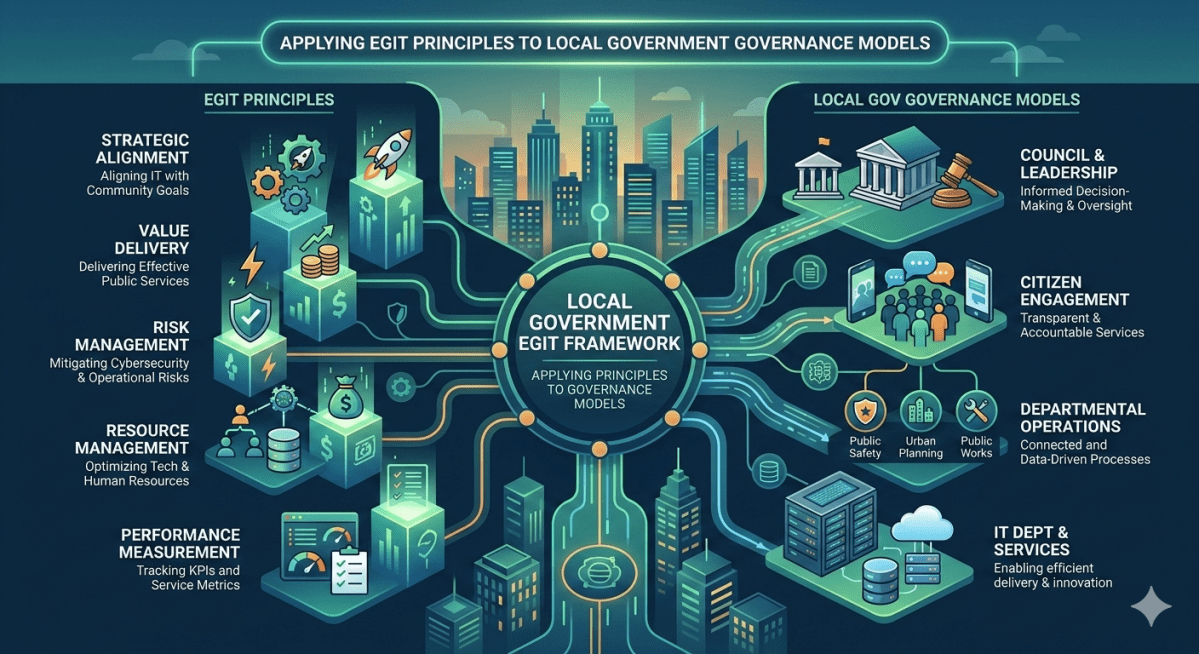
Applying EGIT Principles to Local Government Governance Models

As local governments embrace digital transformation, they face a dual challenge: delivering efficient, citizen-centered services while managing the growing risks of operating in a digital-first environment. One essential model for supporting this shift is the Enterprise Governance of Information and Technology (EGIT) framework. EGIT enables municipalities to align technology investments and digital service delivery with broader goals such as resilience, transparency, and public trust 

At its core, EGIT emphasizes two interdependent responsibilities:

  • Delivering value to the public through the effective use of data and digital tools.
  • Managing risk, including cybersecurity, as an integral part of governance.

To operationalize these principles, local governments can explore example governance models that support strategic alignment across departments.


Model 1: Risk-Informed Leadership Structure

This model integrates EGIT by embedding cybersecurity and digital risk into executive decision-making. Department heads and elected officials receive regular briefings on technology risks, and cybersecurity leaders participate in strategic planning sessions.

EGIT Application:

  • Risk is treated as a governance issue, not just a technical one.
  • Technology decisions are evaluated for both service impact and risk exposure.
  • Cybersecurity leaders have a seat at the table, ensuring independent risk assessments.

Model 2: Functional Separation of IT and Cybersecurity

EGIT calls for a clear distinction between IT operations and cybersecurity oversight. In this model, IT teams focus on service delivery and infrastructure, while cybersecurity teams independently assess threats, monitor compliance, and guide risk mitigation.

EGIT Application:

  • Prevents operational demands from compromising security.
  • Enables unbiased risk reporting and prioritization.
  • Supports resilience by ensuring that security is not subordinated to convenience or cost.

Model 3: Departmental Alignment Through Governance Councils

This model establishes a cross-functional governance council that includes representatives from IT, cybersecurity, finance, legal, and public services. The council reviews technology initiatives, evaluates risk, and ensures alignment with strategic goals.

EGIT Application:

  • Promotes transparency and shared accountability.
  • Aligns digital investments with community priorities.
  • Facilitates coordinated responses to emerging threats.

Model 4: Citizen-Centric Digital Service Oversight

EGIT emphasizes delivering public value. This model focuses on measuring the impact of digital services—such as online permitting, emergency alerts, and citizen portals—against metrics like accessibility, equity, and trust.

EGIT Application:

  • Uses data to evaluate service performance and user satisfaction.
  • Ensures that digital tools enhance—not hinder—public engagement.
  • Balances innovation with privacy and security protections.

EGIT is more than a framework—it’s a mindset. By applying EGIT principles to governance models, local governments can build structures that support innovation while safeguarding public assets. Whether through leadership integration, functional separation, or cross-departmental alignment, EGIT helps municipalities navigate the complexities of digital transformation with confidence and clarity.