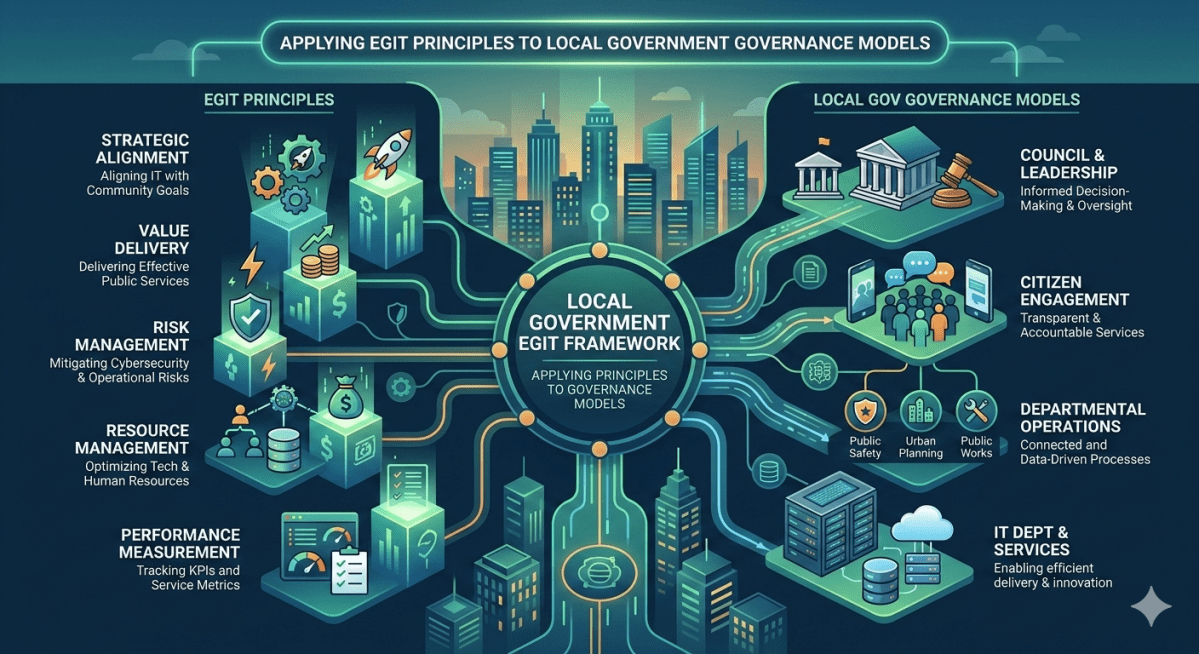
As local governments embrace digital transformation, they face a dual challenge: delivering efficient, citizen-centered services while managing the growing risks of operating in a digital-first environment. One essential model for supporting this shift is the Enterprise Governance of Information and Technology (EGIT) framework. EGIT enables municipalities to align technology investments and digital service delivery with broader goals such as resilience, transparency, and public trust
At its core, EGIT emphasizes two interdependent responsibilities:
- Delivering value to the public through the effective use of data and digital tools.
- Managing risk, including cybersecurity, as an integral part of governance.
To operationalize these principles, local governments can explore example governance models that support strategic alignment across departments.
Model 1: Risk-Informed Leadership Structure
This model integrates EGIT by embedding cybersecurity and digital risk into executive decision-making. Department heads and elected officials receive regular briefings on technology risks, and cybersecurity leaders participate in strategic planning sessions.
EGIT Application:
- Risk is treated as a governance issue, not just a technical one.
- Technology decisions are evaluated for both service impact and risk exposure.
- Cybersecurity leaders have a seat at the table, ensuring independent risk assessments.
Model 2: Functional Separation of IT and Cybersecurity
EGIT calls for a clear distinction between IT operations and cybersecurity oversight. In this model, IT teams focus on service delivery and infrastructure, while cybersecurity teams independently assess threats, monitor compliance, and guide risk mitigation.
EGIT Application:
- Prevents operational demands from compromising security.
- Enables unbiased risk reporting and prioritization.
- Supports resilience by ensuring that security is not subordinated to convenience or cost.
Model 3: Departmental Alignment Through Governance Councils
This model establishes a cross-functional governance council that includes representatives from IT, cybersecurity, finance, legal, and public services. The council reviews technology initiatives, evaluates risk, and ensures alignment with strategic goals.
EGIT Application:
- Promotes transparency and shared accountability.
- Aligns digital investments with community priorities.
- Facilitates coordinated responses to emerging threats.
Model 4: Citizen-Centric Digital Service Oversight
EGIT emphasizes delivering public value. This model focuses on measuring the impact of digital services—such as online permitting, emergency alerts, and citizen portals—against metrics like accessibility, equity, and trust.
EGIT Application:
- Uses data to evaluate service performance and user satisfaction.
- Ensures that digital tools enhance—not hinder—public engagement.
- Balances innovation with privacy and security protections.
EGIT is more than a framework—it’s a mindset. By applying EGIT principles to governance models, local governments can build structures that support innovation while safeguarding public assets. Whether through leadership integration, functional separation, or cross-departmental alignment, EGIT helps municipalities navigate the complexities of digital transformation with confidence and clarity.
 Local Government Cybersecurity Alliance